
 The 2026 Caribbean Premier League (CPL), the fourteenth season of “The Biggest Party In Sports,” has ended. The Antigua & Barbuda Falcons, playing in only their third season, comfortably defeated the debutants, newly named and owned, Jamaica Kingsmen in the September 19 Barbados Kensington Oval-hosted Final.
Played before a near-capacity crowd, the exciting Final was a fitting conclusion to an overall T20 season that has provided some useful takeaways toward the further development of West Indies white ball cricket. Maybe even as well, an impending Test squad selection suggestion for West Indies head Coach/Chief Selector Daren Sammy!
The 2026 CPL Season comprised seven competing franchises: Antigua & Barbuda Falcons, Barbados Tridents, Guyana Amazon Warriors, Jamaica Kingsmen. St Kitts-Nevis Patriots, St Lucia Kings and Trinbago Knightriders, each playing ten Preliminary Round matches. A round-robin schedule which then led to a three-match Playoffs, followed by the season-ending Final.
For participating batters and bowlers, the season schedule, therefore, presented a maximum of thirteen matches for those whose teams progressed all the way to the September 19 Final. But, by comparison, only ten matches for players who found themselves unfortunate enough to be on teams, such as the 2025 defending champions TKR, the SKN Patriots and StL Kings, which had failed to progress to the Playoffs.
Among globally recognized T20 Leagues such as the CPL, 300 runs scored at a 30+ average has long since become universally recognized as the minimum acceptable standard for self-respecting batters. As such, from a West Indies white-ball cricket perspective, the first somewhat discouraging, if not wholly alarming, takeaway from CPL’26 must be the reality that only two local Caribbean batters, Shimron Hetmyer and Shai Hope, scored over 300 runs during the entire tournament.
In what to date must now easily rank as his best ever CPL season, Hetmyer compiled 367 runs at an average of 45.87 and, even more commendably, a 197.31 strike rate that was comfortably the highest among all topline batters. Hetmyer ended the season as its second-highest run scorer, marginally behind top-ranked South African Quinton de Kock (QDK), who scored 392 runs at a 43.55 average from 11 matches played. By comparison to Hetmyer, de Kock’s strike rate was 143.06.
As previously indicated, apart from Hetmyer, West Indies T20 captain Shai Hope, with 332 runs from his 12 played matches, was the only other Caribbean batter to cross the coveted 300-run tournament aggregate mark. There were, however, commendable 250+run returns from Nicholas Pooran (283/9 – Avg. 35.37), his unrelated namesake Kamil Pooran (273/8- Avg. 39.00), Rovman Powell (261/13 – Avg. 29.00) and Keacy Carty (259/13 – Avg.21.58).
Kamil Pooran’s accomplished CPL’26 batting runs scored aggregate has since deservedly earned him a maiden call-up to the West Indies T20I squad. For its forthcoming September 27 – October 3, 2026 T20I series visit to India.
Born June 13, 1996, Kamil Pooran, however, recently celebrated his 30th birthday. A reality which makes the fact that he is only now emerging as a top-flight T20 batter at such an advanced age, and so relatively late in his career, somewhat alarming. Simply because of the correspondingly sad reality that his late emergence has long since become a most noticeable trend among far too many West Indian cricketers, particularly batters!
As a direct manifestation of that reality, even the most cursory examination of this year’s CPL batting statistics would reveal very damming highly supportive evidence! Far too many of the remaining top sixteen ranked, Caribbean-born, batters who scored 200 plus runs during the entire tournament were aged over 30!
Those ranged from the 38-year-old Andre Fletcher, through Evin Lewis at 34, to the now 31-year-old Brandon King. Amir Jangoo (29), Sherfane Rutherford (28) and Zachary Carter (19) were the only, most welcomed, exceptions to that highly discouraging occurrence.
The presence of “aged” players within the top-order batting for each of the participating ’26 CPL franchises was, however, not in any way exclusive to those of Caribbean-born heritage. Indeed, punctuated as it was by the participation of so many 30+ players, this year’s ’26 CPL seemed distinctively geriatric.
Surely the time must now have come for the likes of the 47-year-old Imran Tahir, Colin Munro (39), Kieran Pollard(39), Andre Russell (38), Andre Fletcher (38), Sunil Narine (38), Dwaine Pretorius (37), Johnson Charles (37) and Alex Hales (37) to all exit left from the CPL stage, thereby making way for much younger players. Otherwise, their failure to do so might very soon result in the CPL being rightfully renamed and henceforth regarded as “The Biggest Geriatric Party In Sports!”
Notwithstanding its undeniable geriatric flavor, CPL2026 did, however, manage to produce some very encouraging overall performances from its younger players. Of those, and among the batters, the still 0nly 19year-old Zachary Carter’s return of 206 runs from 11 matches played, albeit at a subpar 18.72 average and minimally acceptable 122.61 strike rate, would have been the most encouraging.
The 25-year-old local-born Jamaica Kingsmen opener Kirk McKenzie also had a commendable season. Falling just marginally short of the 200-aggregate mark, with 194 runs from 12 matches played, a 17.63 average and 123.50 strike rate.
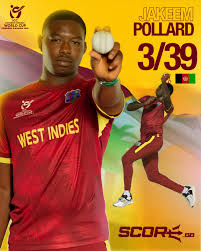
It was from among the bowlers that this year’s 2026 CPL, however, produced its most exciting prospect, certainly in terms of the immediate future of West Indies cricket! It came in the form of the gangly 18-year-old Barbados Trident’s local-born left-arm pacer Jakeem Javier Pollard.
Fresh from his eye-raising performances in the most recent ICC U19 50 Over World Cup, and playing in his maiden CPL season, Pollard at times bowled with searingly raw pace that proved highly disconcerting to even the League’s very best batters. Including Nicholas Pooran and Rovman Powell!
Arguably not since Michael Holding’s emergence, as an abundantly raw pace-blessed teenager during the 1973 Shell Shield Season, has there ever been a more exciting prospect for West Indies cricket. With all due respect, of course, to Ian Bishop and others of that ilk who were also teenage prodigies.
What’s even more exciting about Pollard, however, is of course that he is a left-arm bowler. A variety that the West Indies has not ever really had a history of producing top-rated exponents of.
The late Sir Garfield Sobers, Pedro Collins, Ian Bradshaw, Bernard Julien, Sheldon Cottrell and Obed McCoy are the left-arm seamers that immediately come to mind, among those who have represented West Indies in any of cricket’s three international formats. None of whom were nearly as quick as Pollard has already demonstrated, at such a young age and at this very early stage of his emerging cricket career!
Pollard’s emergence during this year’s CPL was certainly exciting in terms of the immediate future of West Indies white-ball cricket. If his obvious raw talent potential bears fruit, he could very easily be a part of the West Indies white-ball setup for the immediate future. Maybe even as soon as the 2028 T20 World Cup.
In terms of Pollard’s future, the far more exciting prospect should, however, now be in terms of his development as a red-ball, potential Test cricketer. Back during the mid to late seventies, the West Indies selectors of that era took major chances on the then obvious, but as yet totally undeveloped, talents of Michael Holding and later Malcolm Marshall.
Having played a bare minimum of domestic first-class cricket matches, first Holding, then subsequently Marshall, were included in West Indies squads to Australia and India respectively. And as the saying goes, the “rest is history!” As evidenced by their subsequent respective emergence as two of the greatest fast bowlers West Indies and world cricket have ever seen.
West Indies next Test engagement will be a two-match tour to Bangladesh this coming October – November. An ideal opportunity, if there ever was one, to include Pollard in the chosen squad. Just to get him exposed to that environment. Simply observing and learning from the exploits of Kemar Roach, Jayden Seales and the two Josephs, Alzarri and Shamar.
Aged 38 and having already taken 308 wickets, Kemar Roach must now surely be in the very last stages of his outstanding Test cricket career. With him at its helm and along with the aforementioned Jayden Seales and two Josephs, Alzarri and Shamar, the West Indies now possess a four-prong Test bowling pace attack fully capable, when performing at their very best, of capturing the twenty opponents’ wickets required to win a Test match.
Roach’s eventual retirement might then provide the fourth-prong space for his immediate replacement. Jakeem Pollard’s potential emergence as a suitable left-arm high-paced replacement would even now, at such an admittedly premature stage, be well worth pursuing!
The final takeaway from this year’s CPL would be that in terms of its demonstrated crowd support, the interest in and passion for cricket still very much exists among the sport’s Caribbean fans and followers. Both within the region and even further abroad to the American and Canadian diasporas!
For Cricket West Indies (CWI) head honchos, particularly CEO Chris Dehring, witnessing so many repeated images of thousands of fans decked in the representative shirts of their respective franchises must surely have created merchandising envy of the highest degree. If only CWI could somehow manage to convince a mere fraction of its own reportedly 225 million-strong fan base to similarly purchase West Indies team shirts, what a much-needed financial bonanza that would be!
Perhaps even in amounts sufficient to enable funding of the various CWI youth development initiatives and tournaments. Those, including its own T20 Breakout Tournament, that a lack of available funding has reportedly caused to be abandoned!